
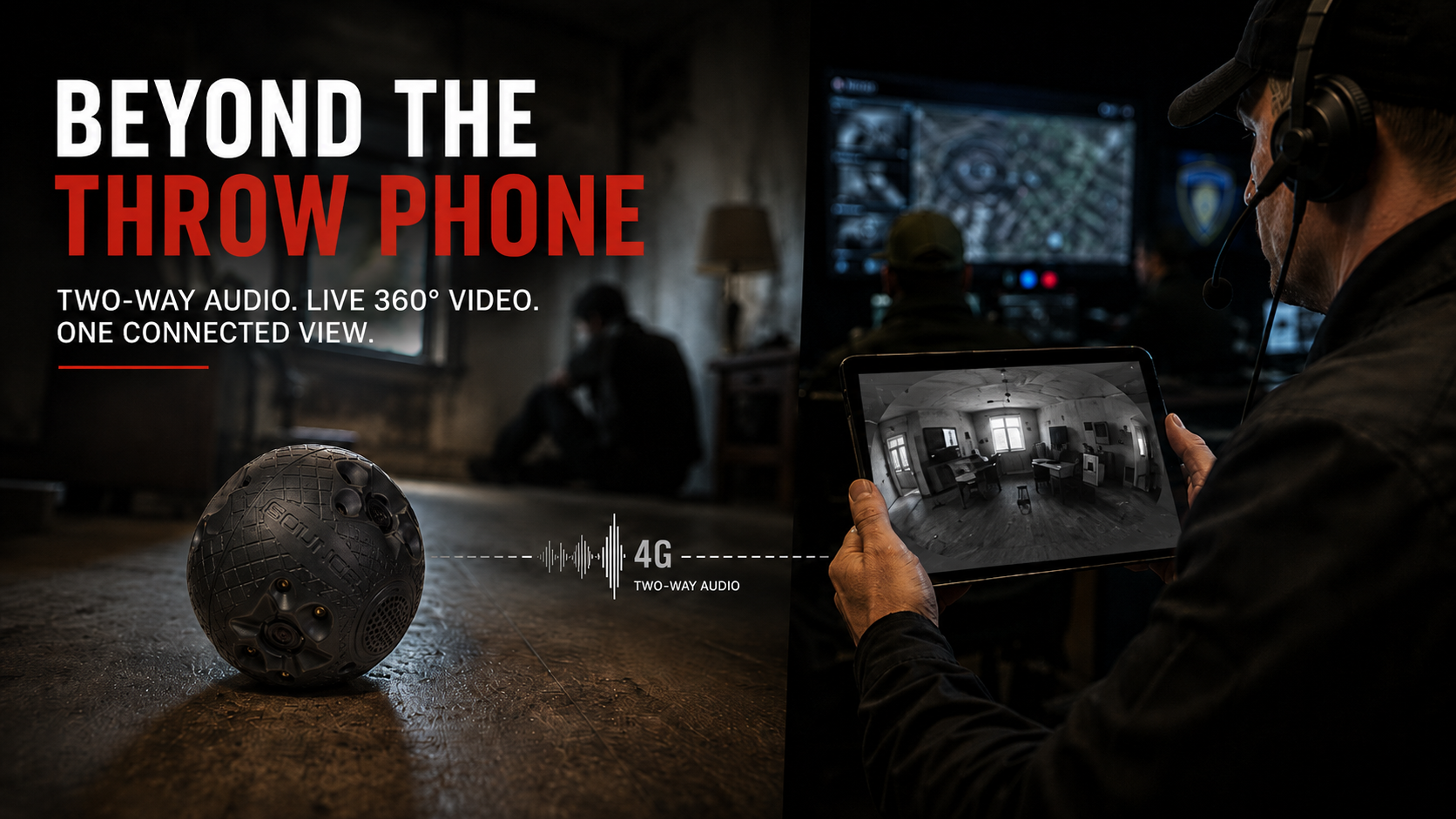
For decades, crisis negotiation teams have relied on the throw phone to establish direct communication with barricaded subjects and hostage takers. The concept is straightforward: deliver a dedicated communications device into the structure, create a reliable connection, and give trained negotiators the time and access they need to work toward a peaceful resolution.
Communication remains essential. But communication alone does not provide the full operational picture.
Bounce Imaging’s new 4G two-way audio capability pairs secure remote communication with live, omnidirectional 360° video—giving crisis negotiators and tactical teams the ability to communicate with a subject while simultaneously seeing the environment around the device.
It is more than a modern throw phone. It is a communications platform, observation tool, and shared source of real-time situational awareness—all in one throwable system.
The Traditional Throw Phone Solves Only Half the Problem
A conventional throw phone can help establish a controlled line of communication, particularly when officers cannot safely approach a subject. But once the device is delivered, the incident command team may still have limited visibility inside the location.
Negotiators can hear what a subject says. They may also hear movement, voices, distress, or background noise. Yet they are often forced to interpret those sounds without being able to see:
- Who is near the device
- Whether hostages are present or moving
- Whether the subject is holding a weapon
- Whether the subject’s behavior matches their statements
- Whether conditions inside the room are changing
- Whether someone other than the primary subject is attempting to communicate
- Whether a medical emergency may be developing
That gap matters. Crisis negotiation is a disciplined process built on communication, active listening, behavioral assessment, coordination, and time. The FBI has described crisis negotiation as a critical capability that helps protect officers and recover hostages and victims, while active listening remains one of the discipline’s central techniques.
Bounce Imaging adds another layer to that process: the ability to see the environment while the conversation unfolds.
Communication and Visibility From One Throwable Device
With Bounce Imaging’s 4G two-way audio capability, teams can deploy a rugged throwable camera into a structure and establish two-way communication without relying solely on the camera’s immediate Wi-Fi range.
At the same time, the system transmits live 360° video, allowing authorized users to independently look in different directions from their phones or tablets. Bounce Imaging’s platform is designed so multiple team members can view the environment simultaneously while the system records video and audio for later review and evidentiary purposes.
That means the negotiator can focus on the conversation while other personnel maintain visual awareness.
The crisis negotiation team can listen for changes in tone and behavior. Tactical commanders can observe movement and environmental conditions. Incident command can maintain a broader understanding of the scene. Each discipline receives information relevant to its role without interrupting the negotiator or requiring another device to be introduced.
Why 360° Video Changes the Equation
A fixed camera only shows what is directly in front of it. During a dynamic hostage or barricade incident, that may not be enough.
A subject can move behind the camera. A hostage can enter from another part of the room. A door can open outside the original field of view. An object can be placed beside or behind the device. A traditional camera may need to be remotely repositioned—or may simply miss the event.
A 360° camera captures the entire surrounding environment.
Once deployed, team members can independently examine different areas around the device without physically moving it. One user might observe the subject. Another might watch a doorway. A third might assess a hostage or scan for changes elsewhere in the room.
Instead of receiving a single narrow view, the team gains a shared visual picture that can continue developing throughout the incident.
That can help answer questions that audio alone cannot:
- Is the person speaking actually alone?
- Does the subject appear injured, impaired, agitated, or increasingly calm?
- Are hostages visible?
- Is anyone being moved or threatened?
- Are weapons or hazardous objects visible?
- Has the physical environment changed since the last conversation?
- Is the subject approaching the device in a way that could affect communication?
- Are there visual signs that the negotiation may be progressing—or deteriorating?
Visual information does not replace the judgment of trained negotiators or tactical leaders. It gives them more information on which to base that judgment.
A Shared Operating Picture for Negotiators and Tactical Teams
Hostage incidents require close coordination among crisis negotiators, tactical personnel, intelligence staff, incident commanders, emergency medical personnel, and other supporting resources.
Yet these groups may experience the same incident very differently.
The negotiator hears the subject’s words and emotional state. Tactical operators focus on threats, movement, access points, and contingency planning. Command staff must weigh the totality of the information and make decisions under significant uncertainty.
A throwable 360° video and audio system creates a common source of information across those functions.
The negotiator does not need to describe every background sound to the tactical team. Tactical personnel do not need to interrupt the negotiation channel to ask whether something has moved. Command staff can better understand what teams are reporting because they have access to the same visual context.
This shared awareness can improve the quality and speed of internal communication while preserving the deliberate, methodical nature of crisis negotiation.
More Context for Behavioral Assessment
Negotiators are trained to listen carefully—not only to what a subject says, but also to how it is said. Tone, pacing, emotional intensity, responsiveness, threats, concessions, and changes in language can all contribute to the team’s assessment of an unfolding crisis.
Video can add context to those observations.
A subject may verbally claim to be calm while visibly pacing, handling a weapon, or acting aggressively toward another person. Conversely, a subject whose words initially appear confrontational may demonstrate visual signs that they are becoming less agitated and more receptive to dialogue.
The FBI’s Crisis Negotiation Unit has emphasized the importance of assessing indicators of negotiation progress and violence risk in hostage and barricade incidents. More complete real-time information can support that assessment, although it does not replace established negotiation protocols, training, or professional judgment.
The value is not simply “seeing the suspect.” It is understanding the relationship between the conversation and what is happening in the environment.
Establish Communication Without Giving Up Distance
Traditional systems can require dedicated cables, specialized consoles, or personnel positioned within a particular operating range. Cellular connectivity can give teams greater flexibility in where negotiators and command personnel establish their working positions.
With 4G connectivity, authorized personnel may be able to monitor and communicate through the system from farther away than a conventional local wireless connection would permit, subject to network coverage and operational configuration.
That flexibility can help teams:
- Maintain safer standoff distances
- Position negotiators in a quieter, more controlled environment
- Share access with command personnel at another location
- Reduce crowding near the tactical command post
- Preserve communications if the incident footprint expands
- Continue monitoring from protected positions
The camera remains inside the operational environment. The people who need its information do not have to be.
One Deployment, Multiple Capabilities
Every additional device introduced into a barricade or hostage environment creates another operational task.
A team may need one platform for communication, another for observation, another for recording, and additional equipment to extend the signal. Each device must be transported, deployed, managed, powered, and incorporated into the response plan.
Bounce Imaging consolidates several of those functions into a single throwable platform:
Two-way communication. Live 360° video. Audio monitoring. Remote multi-user viewing. Recording. Cellular connectivity.
The system can be thrown, rolled, lowered, or placed depending on the environment and the team’s deployment plan. Bounce Imaging cameras are designed for hostage incidents, barricaded subjects, high-risk warrants, building searches, and other situations in which officers need immediate visibility without entering the space themselves.
For crisis negotiation teams, this means the device used to begin the conversation can also become the team’s visual presence inside the location.
Understanding What Happens Between Conversations
Negotiations do not consist of uninterrupted dialogue. Subjects may walk away from the phone, stop responding, speak with hostages, move around the structure, or spend long periods in silence.
With an audio-only system, those periods can leave teams with little information.
Live 360° video can help personnel observe what happens when the subject is not actively speaking. The camera may provide context around pauses, changes in behavior, interactions among occupants, or movement elsewhere in the room.
That persistent awareness may prove especially important when the subject disconnects, refuses to answer, or moves the communications device.
Instead of losing nearly all insight when the conversation pauses, the team may continue gathering useful visual and auditory information.
Supporting Negotiation—While Preparing for Every Outcome
The goal of crisis negotiation is to create time, establish rapport, reduce emotional intensity, gather information, influence behavior, and work toward a voluntary and peaceful resolution.
At the same time, tactical teams must remain prepared if the situation changes and an emergency intervention becomes necessary.
A throwable 360° camera can support both missions.
During negotiations, it provides visual context and a communications channel. During tactical planning, it may help teams better understand the environment, identify hazards, observe occupants, and evaluate changing conditions.
If an intervention becomes necessary, personnel may have more current information than they would have had through audio communication alone.
That does not eliminate uncertainty. It reduces the amount of the environment that remains unseen.
A Modern Alternative to the Traditional Throw Phone
The throw phone was developed to solve a critical problem: how to communicate with someone inside a dangerous environment without placing a negotiator or officer directly in harm’s way.
Bounce Imaging preserves that core capability and expands it.
Now, teams can communicate and observe from the same deployable device. Negotiators can hear the person in crisis. Tactical teams can see the surrounding environment. Incident commanders can access a shared operating picture. Multiple authorized users can examine different areas of the scene at the same time.
The result is not simply a throw phone with a camera attached.
It is a new way to approach crisis communication—one that combines the human skill of negotiation with the situational awareness of live 360° video.
See More. Understand More. Negotiate With More Information.
The most important tool in a hostage negotiation will always be the trained professional conducting the conversation.
Technology should support that person—not distract from them.
Bounce Imaging’s 4G two-way audio and 360° video capability gives negotiators and tactical teams something they have historically had in limited supply: immediate visual context inside the crisis environment.
Because when every word matters, seeing what is happening around those words can change the game.
Ready to explore a modern alternative to the traditional throw phone?
Contact Bounce Imaging to schedule a demonstration and learn how 4G two-way audio and live 360° video can support your crisis negotiation and tactical response teams.